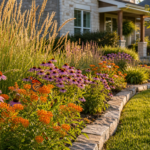
If you have watched a patio settle into a low spot after three winters, or seen a retaining wall start to lean out at the top, you have already learned the hard lesson about hardscaping in Kansas City. It is not the stone that fails. It is what is underneath the stone.
Our clay soil swells when it is wet and shrinks when it is dry, and it does that every year, in both directions. The Johnson County extension office puts it plainly: that pressure is “great enough to crack foundations and basement walls, and move concrete sidewalks.” A patio built on four inches of poorly compacted gravel is not going to win that argument. A patio built correctly will outlast the house. This is a guide to knowing the difference before you sign anything, and to why fall is a better time to start than most homeowners assume.
Why Hardscaping in Kansas City Is Harder Than It Looks
Two things are working against your patio here, and they work together.
The clay. Johnson County soils carry very high clay content. When clay takes on water it expands, and when it dries it contracts and cracks. As K-State Research and Extension’s guide to shrink-swell clay soils describes, those cracks can run from whisper thin to an inch or more wide, and the pressure involved is enough to move flatwork. Clay also holds water, which brings us to the second problem.
The freeze and thaw. Water trapped in a saturated base expands when it freezes and lets go when it thaws. Do that repeatedly across a Kansas City winter and an improperly built base loses its structure. The pavers do not crack, they just stop sitting level, and by year three you have a birdbath in the middle of your patio and a wall that has rotated forward.
This is why the industry standard treats our conditions as a special case rather than the default. The Interlocking Concrete Pavement Institute, now the Concrete Masonry and Hardscapes Association, states that geotextile separation fabric may be used where soil remains saturated part of the year, where there is freeze and thaw, or over clay and moist silty subgrade soils. Johnson County routinely presents all three. Fabric is not an upsell here. It is exactly the condition the standard has in mind.
The Base Numbers You Can Check on a Quote
Most homeowners cannot evaluate a bid for hardscaping in Kansas City because the part that determines whether the project survives is buried and invisible by the time anyone sees it. So here are the actual published numbers, from ICPI Tech Spec 2, the industry construction standard.
Base depth. A minimum of 4 inches of compacted aggregate base for a patio or walkway over well drained soils, and at least 6 inches for a residential driveway. Then the line that matters most here: colder climates with wet or weak soils require a base 2 to 4 inches thicker. That describes Johnson County exactly, which is why a properly built Kansas City patio typically starts at 6 to 8 inches of base, not 4.
Bedding sand. A nominal 1 inch, uncompacted, meeting ASTM C33. Thicker is not better. A deep sand layer is a place for pavers to move.
Compaction. At least 98 percent of standard Proctor density on both the subgrade and the base, in lifts, with a plate compactor. This is the step that gets skipped on cheap installs, because it is slow and nobody can see whether it happened.
Slope. A minimum of 1.5 percent surface slope so water leaves the patio instead of sitting on it. On a 15 foot patio that is about 2.7 inches of fall, which is more than most people expect and less than anyone notices underfoot.
Edge restraint. At least 1 inch of vertical restraint in contact with the side of the paver. Without it, the outside course walks outward a little more every year and the field opens up behind it.
Ask a bidder for those five numbers in writing. A contractor who builds correctly will answer without hesitating, because they are already pricing it that way. If a quote comes in dramatically below the others, one of those five is usually where the money went.
Retaining Walls, and the Permit Detail That Catches People
Retaining walls follow a different set of rules, and there is a local wrinkle worth knowing before you design one.
Most Johnson County cities exempt walls under 4 feet from a permit. But the cities do not all measure the 4 feet the same way. Olathe and Shawnee measure from the bottom of the footing to the top of the wall. Kansas City, Missouri measures from grade on the low side. That difference is not academic: a wall showing three and a half feet of exposed face can be over 4 feet once the buried base course counts, which moves it from exempt to permitted.
Lenexa adds a second trigger that almost nobody knows about. Per the city’s remodeling permit list, a retaining wall needs a permit if it is over 4 feet or if a wall under 4 feet alters water flow at a lot line. Plenty of terracing projects do exactly that without anyone thinking about it.
Where a permit is required, expect the city to want plans prepared by a Kansas registered engineer. Shawnee states that requirement outright, and it adds a Land Disturbance Permit for projects within 50 feet of a natural or improved drainage way.
One myth worth clearing up: a segmental block wall does not need its leveling pad below the 36 inch frost depth that governs house footings in Johnson County. The manufacturers’ installation standard is explicit that the leveling pad does not need to go below the frost line as long as the bearing capacity is there. What a wall does need is drainage. At least 12 inches of clean drainage aggregate behind the block, a perforated drain pipe at the base, and outlets spaced not more than every 50 feet and at low points along the wall. Walls in Kansas City do not fail from frost. They fail from water pressure that had nowhere to go.
Why Fall Is the Right Time to Start
There is a widespread assumption that hardscape season ends around Labor Day. It does not, and fall has real advantages if you plan for the calendar rather than against it.
The ground cooperates. Compaction to 98 percent Proctor is not achievable in frozen or saturated ground. Fall in Kansas City generally gives drier, workable soil than a wet spring, which is the condition the spec actually calls for.
The planting window is open at the same time. Most hardscape projects have a softscape half, and K-State’s fall planting guidance for Johnson County puts the window between early September and the end of October. Fall planting lets roots develop before winter so the plant is established before the following summer arrives. Planting later into November cuts that root growth short. If you want the beds and the patio finished together, this is the season where both are correct at once.
There is a real deadline, and it is a date. The average first 32 degree freeze is October 23 in Olathe and October 28 in Kansas City, per the National Weather Service. After that, Johnson County’s cold weather concreting procedures start governing the work. They apply any time the air temperature has fallen to, or is expected to fall below, 40 degrees, and they bring required freeze protection and controlled surface temperatures onto the job site. Projects do not become impossible, they become slower and more expensive. Booking in September means you are ahead of that, not negotiating with it.
Design now, build now, or build first thing. Even if a project cannot break ground until spring, fall is when the design, the survey, the permit, and the material selection should happen. Spring crews book out. The homeowners who get a spring install are the ones who signed in October.
The Lenexa Rebate Almost Nobody Uses
If you live in Lenexa and permeable pavers are on the table, there is money available and a deadline attached to it.
Lenexa’s Cost Share Program reimburses 75 percent of eligible expenses for stormwater-friendly improvements, including permeable pavers, rain gardens, and native plantings, up to a $1,500 project cap. Native trees are covered at $225 each. The program is first come, first served, funds for the current year have already been allocated, and the next application period opens in March 2027.
That timing is the whole point of mentioning it in September. A design and a quote in hand in the fall means an application ready to submit the morning the window opens, rather than starting from scratch in March and finding the money gone. Homeowners in other Johnson County cities should look at the county’s Contain the Rain program, which covers up to 50 percent of eligible expenses across more than a dozen participating municipalities.
What These Projects Actually Return
Honest answer: it depends on which project, and the numbers are not uniform.
The National Association of Realtors and the National Association of Landscape Professionals publish a Remodeling Impact Report on outdoor features that puts real percentages on this. A new patio recovers about 95 percent of its cost and scores 9.9 out of 10 on homeowner satisfaction. An overall landscape upgrade recovers about 100 percent. Standard lawn care service recovers 217 percent, which is the highest number in the report by a wide margin.
Then there are the projects that do not pencil out on resale and are worth doing anyway. Landscape lighting recovers about 59 percent of its cost. A fire feature recovers about 56 percent. Landscape lighting also scores a perfect 10 on the satisfaction scale, higher than the patio does, and the fire feature scores 9.7.
We would rather tell you that straight than quote you a single flattering percentage. Buy the patio partly for the resale math. Buy the lighting and the fire pit because you will use them four nights a week in October, and price them as something you are buying for yourself.
Frequently Asked Questions
Is it too late to install a paver patio in Kansas City in the fall?
Usually, no. September and October are good installation months here, and drier fall soil often compacts better than wet spring ground. The practical limit is weather, not the calendar. Once temperatures drop below the range where concrete work is permitted, projects slow down. Booking in early fall keeps you ahead of that.
How deep should the base be for a paver patio in Kansas?
Industry standard is a minimum of 4 inches of compacted aggregate base over well drained soil, but the same standard adds 2 to 4 inches for cold climates with wet or weak soils. Johnson County qualifies. Expect 6 to 8 inches of base on a properly built patio here, plus geotextile fabric over the clay.
Do I need a permit for a retaining wall in Lenexa or Olathe?
Generally a permit is required for walls over 4 feet. Lenexa also requires one for a wall under 4 feet if it alters water flow at a lot line. Cities measure the 4 feet differently, some from the bottom of the footing, so verify with your city before you assume a wall is exempt.
Why does my patio sink or heave every winter?
Almost always because water is getting into the base and freezing. That points to one of three things: not enough base depth, base that was never compacted properly, or no separation fabric between the clay and the gravel so the two mixed together. Surface slope and edge restraint are the other common culprits.
Can I get money back for a permeable paver patio in Lenexa?
Yes. Lenexa’s Cost Share Program reimburses 75 percent of eligible permeable paver expenses up to a $1,500 project cap. It is first come, first served, and the next application window opens in March 2027. Having a design and quote ready before it opens is the difference between getting funded and missing it.
Build It Once, and Build It for This Climate
Hardscaping in Kansas City is a soil project with stone on top. Get the base depth, the compaction, the fabric, the slope, and the drainage right, and the surface takes care of itself for decades. Get them wrong and no amount of premium paver fixes it.
If you would rather have someone handle the survey, the permit, and the spec, that is what we do. Contact 4T Total Lawn or call us at 913-888-0997 to talk through your project. We build with Belgard and Versa-Lok systems chosen for Midwest conditions, our landscaping and hardscaping team will walk your property and tell you honestly what it needs, and we have been building outdoor spaces in Johnson County since 1977.
Related reading: Native Plants for Kansas Residential Landscapes and our residential project gallery.